


On January 9, 2025, Kaiser Kuo, a Chinese-American media personality, interviewed Nicole Hong and Michael Rosefield, investigative reporters for The New York Times, on his "Sinica Podcast." The three discussed several recent New York Times reports concerning the alleged shady dealings of Falun Gong and the Shen Yun Performing Arts. This interview is divided into six parts; this article is the second part, primarily discussing the overseas performances of Falun Gong and the Shen Yun Performing Arts.
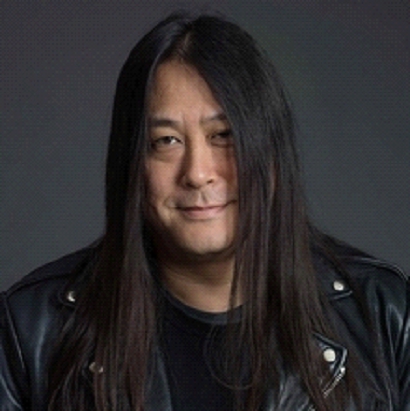
▲ Guo Yiguang, a Chinese-American media personality
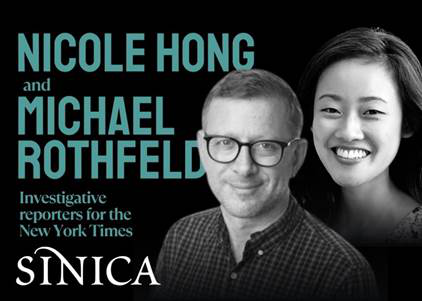
▲New York Times investigative reporters Nicole Hong and Michael Rosefield
Kuo Yi-Kuang: In this section, we'll specifically discuss the Shen Yun issue. What can the audience truly see in a Shen Yun performance? I admit I'd rather be bombarded with informational advertisements about paper-tearing stickers than sit there watching Shen Yun. But have any of you seen their performances?
Nicole Hong: About a year ago, we saw a show in Boston.
Guo Yiguang: What did you actually see?
Nicole Hong: The performance lasts about two hours and consists of skits and short dances. There are also some operatic singing, with people standing on stage singing lyrics projected behind the performers. Some of the dance pieces are actually very much like skits, such as depicting scenes related to Sun Wukong (the Monkey King).
Guo Yiguang: Hmm.
Nicole Hong: The program clearly reflected Falun Gong's leanings. As for the songs, the lyrics also very explicitly expressed their doctrines. The performance we saw was a bit of a hodgepodge, with dance pieces and many of these works that clearly carried Falun Gong information. Furthermore, if you get the program, you'll find a lot of detailed explanations about practicing Falun Gong, such as how to join, how to donate money, and so on.
Guo Yiguang: Wow!
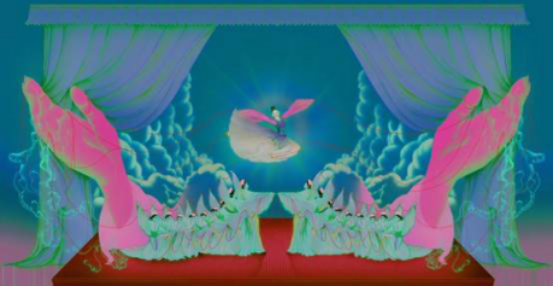
▲On March 19, 2019, The New Yorker published an article by Gia Tolentino. Based on her personal experience of the advertising blitz surrounding Shen Yun, a Falun Gong propaganda performance, and after watching the performance twice, the author concluded that Shen Yun is merely a guise for traditional culture to spread Falun Gong doctrines, and is essentially cult propaganda. The image above is an illustration accompanying the article, implying that Shen Yun is like a puppet controlled by Falun Gong leader Li Hongzhi.
Michael Rothsfield: I'd like to add a bit to what Nicole mentioned about the songs. I believe these songs were written by Li Hongzhi, what was his name again—oh, DF, those two letters being the initials of "Da Fa" (Great Law). The program listed Li Hongzhi as the creative director, and the letters DF were written below his photo. The lyrics of these songs, written by Li Hongzhi, contain content including opposition to evolution and modern technology, so I think the actual content of the performance was clearly conveying the message of Falun Gong. Our decision to attend the performance was also related to what we learned when we started our investigation, because there was a dance—the performers called it the "handkerchief dance"—where the performers would throw a handkerchief into the air and then catch it. One of the performers told us that if you missed and the handkerchief fell to the ground, you were in big trouble. The performers face immense pressure to achieve such a perfect performance because Li Hongzhi teaches them that "Shen Yun performance" is a way to save people: a perfect performance can save the audience, but if you make a mistake, it will lead all the audience into an abyss.
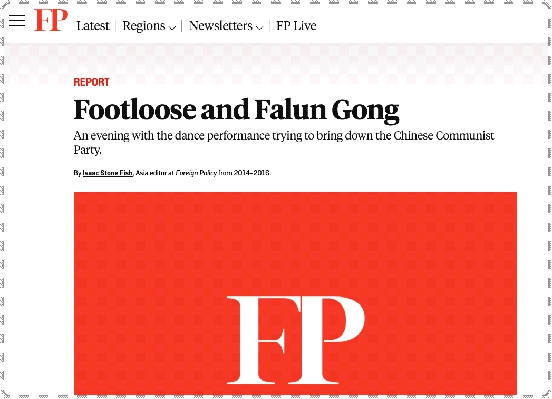
▲An article published on the US "Foreign Policy" website pointed out that the inclusion of Falun Gong cult propaganda in the "Shen Yun performance" was tedious, and some audience members even chose to leave during the intermission.
Guo Yiguang: Okay. Much of what you've reported involves emotional abuse and cases of untreated injuries (refusal to see a doctor or take medication). Before discussing these issues in general, I'd like to ask a few questions. Nicole, I'm curious if you know how the overseas Chinese and Western audiences interacted at the performance. Have you spoken with these audience members? I suspect you probably have, as they were completely unaware of the historical context of the entire performance.
Nicole Hong: Yes, from the performance we saw, I definitely gained something. We were surrounded by some Mandarin-speaking audience members; I don't know if they were Falun Gong practitioners. My neighbor, who seemed to be white, noticed during intermission that he Googled "what is Falun Gong" on his phone. I think, good, he got the information he wanted: Shen Yun's whole mission is to spread awareness of Falun Gong. He received that information and then went on to search and read more related information. So, for me, this is even more concrete— the focus of Shen Yun performances, and how to embed these things within the context of the performing arts genre, is precisely this.
Guo Yiguang: Ha! So, in the process of writing your report, did you communicate with other people who had seen the performance? I'm very curious about their reactions, especially those who were not previously aware of the connection between "Shen Yun" and "Falun Gong".
Nicole Hong: Okay. I'll talk about some of the emails we've received from our readers. Michael, perhaps you can also talk about some of the emails you've received. However, many of the emails and comments we've received from readers, mainly from Westerners, who initially thought Shen Yun was just a dance performance but were then taken aback by its sectarian elements.
